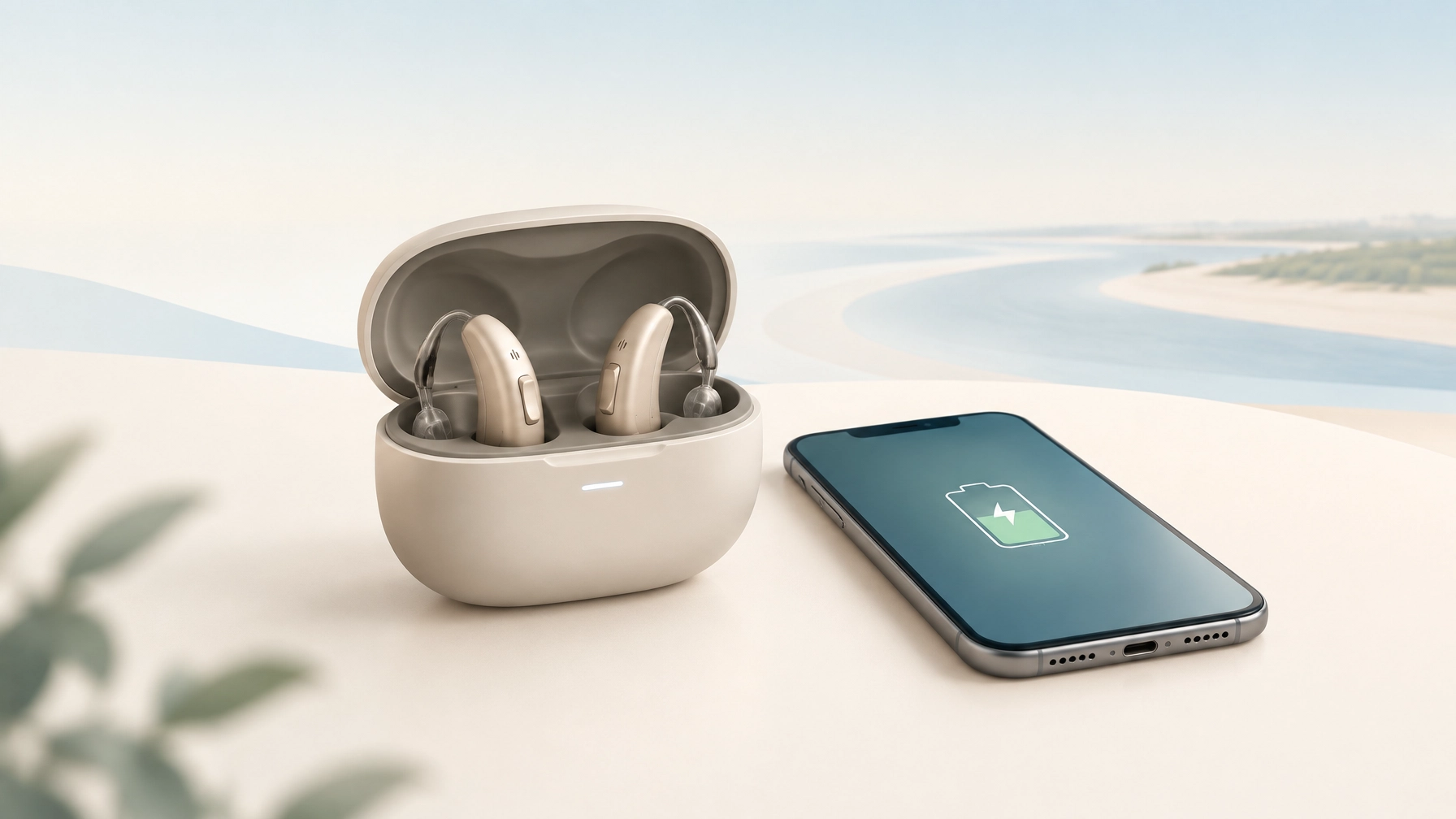
Rechargeable Hearing Aids in 2026: 7 Things to Know Before You Buy in Perth
If you are comparing rechargeable hearing aids with traditional disposable-battery models, you are probably wondering whether the convenience is worth the price.
As an audiologist, I understand the appeal. You place your hearing aids in a charger overnight, put them on in the morning and get on with your day. No tiny zinc-air batteries, no fiddly battery doors and no last-minute dash to the chemist in Perth.
But a rechargeable hearing aid is not automatically the best hearing aid for every person. The quality of the fitting, the physical style, your listening needs and the aftercare you receive matter just as much as battery life.
Here are the seven things I tell my patients to consider before buying rechargeable hearing aids in Perth in 2026.
1. Look beyond the headline battery runtime
Most modern rechargeable hearing aids are designed to provide a full waking day from an overnight charge. In real-world use, many models deliver approximately:
- 16–24 hours with ordinary hearing-aid use
- 20–30 hours or more in higher-capacity models
- Up to 38 hours in selected premium models under lighter-use conditions
One of the headline products for 2026 is the Phonak Audéo EON Sphere. It uses Phonak’s new HYPERSONIC chip and claims up to 38 hours of battery life per charge.
That figure is impressive, but “up to” is important. Battery performance changes depending on:
- The severity of your hearing loss
- How much processing the hearing aids are doing
- Time spent in noisy environments
- Your volume settings
- Bluetooth streaming
- The age and condition of the battery
In practical terms, a device rated for 38 hours may provide considerably less if you stream music, calls and television audio for much of the day.
Practical takeaway: Ask your audiologist, “How many hours should I expect with my daily routine?” Do not make your decision based on the biggest number printed on the brochure.
2. Streaming can reduce battery life considerably
Bluetooth streaming is one of the best features of modern hearing aids. You can stream:
- Phone calls
- Music and podcasts
- Television audio
- Navigation instructions
- Video calls
However, streaming uses more power than ordinary hearing-aid listening. Several hours of continuous streaming can reduce your daily runtime to approximately 16–22 hours, depending on the model.
Auracast is another important development. Auracast (Bluetooth LE Audio broadcast technology) allows compatible hearing aids to receive audio broadcasts from supported televisions, theatres, lecture halls, gyms and public spaces. Instead of pairing one device to one set of hearing aids, you can select an available broadcast, much like choosing a Wi-Fi network.
The Bluetooth SIG Auracast information page explains how this technology is being developed. Some 2026 hearing aids are Auracast-enabled, while others are only Auracast-ready, meaning a future firmware update may be required.
Get your audiologist to confirm:
- Whether Auracast works on the specific model today
- Whether your smartphone supports Bluetooth LE Audio
- Whether the hearing aids require a firmware update
- How much streaming is likely to affect your battery life

3. Choose the right charging case for Perth life and travel
There are two broad types of chargers:
- Desktop chargers, which need to remain connected to mains power
- Portable charging cases, which contain their own internal battery
A portable case is particularly useful if you travel from Perth, spend weekends camping or regularly visit family in regional Western Australia.
Before you buy, ask:
- How many complete recharges does the case provide?
- Can the case be charged with USB?
- Can it be charged from a power bank or car adaptor?
- How long does a full charge take?
- Does a 30-minute quick charge provide several hours of use?
Some modern systems provide multiple extra charges from the case, giving you several days of independence from a wall outlet.
Do not assume every charging case is a power bank. Some cases only protect and charge the hearing aids when plugged into a power source.
For air travel, keep the hearing aids and charger in your hand luggage. Avoid leaving them in a hot car, particularly during a Perth summer, because excessive heat can affect lithium-ion battery performance.
4. Understand lithium-ion lifespan and replacement costs
Rechargeable hearing aids generally use sealed lithium-ion batteries. Lithium-ion means a rechargeable battery technology that stores energy efficiently in a compact space.
The battery is not normally user-replaceable. After approximately three to five years, performance may gradually decline. You may notice that:
- The hearing aids no longer last all day
- One side runs out before the other
- Charging takes longer
- The devices switch off earlier than expected
Australian industry guidance commonly places rechargeable battery replacement at approximately $100–$200 per device, although the actual cost depends on the brand, warranty, repair pathway and model.
Make sure to ask for the written details before purchasing:
- What is the warranty period?
- Is battery replacement included?
- What is the expected out-of-warranty cost?
- Will the device be sent to the manufacturer?
- How long will you be without your hearing aids?
At Pristine Hearing, I can also help with hearing-aid repairs, cleaning, checks, emergency repairs and replacements, including devices originally purchased through another audiologist. Follow-up maintenance is free when you receive a Pristine Hearing aid.
5. Rechargeable models are often easier with arthritis or dexterity problems
Disposable batteries can be difficult to manage. They are small, slippery and easy to drop. For someone with arthritis, tremor, reduced sensation or poor eyesight, opening a battery door every few days can become a genuine barrier.
Rechargeable aids remove much of that problem. You simply:
- Open the charger
- Place each hearing aid into its matching position
- Confirm that the charging lights appear
- Leave them overnight
For patients with dexterity concerns, I usually discuss:
- A slightly larger BTE (Behind-the-Ear) or RIC (Receiver-in-Canal) design
- A charger with magnetic alignment
- Large, easy-to-feel controls
- A stable charger that does not slide across the bedside table
- App-based volume control, if the patient is comfortable using a smartphone

Do not choose the tiniest hearing aid simply because it looks discreet. A device that is easy to handle, clean and charge will usually serve you better than one that is almost invisible but frustrating to use.
6. Have a plan for the morning you forget to charge
Even organised people forget. You might be rushing to Fiona Stanley Hospital, heading to the airport or leaving early for a fishing trip when you realise the charger was never plugged in.
Ask whether your preferred model offers:
- A quick-charge function
- A portable charging case
- A battery-status warning in the smartphone app
- A low-battery alert you can hear or feel
Many models provide useful extra listening time after a short charge. However, this varies significantly, so get the exact quick-charge time in writing.
My practical advice is straightforward:
- Keep the charger in one permanent place
- Charge the hearing aids every night
- Carry the charging case when travelling
- Take a compatible USB power bank on longer trips
- Do not use an unapproved charger
- Keep the charging contacts clean and dry
For some people, disposable batteries remain a sensible backup. For others, a portable case is enough. The right answer depends on your lifestyle, not a generic buying guide.
7. A proper fitting and trial matter more than the specification sheet
This is the most important point.
A premium rechargeable hearing aid can still disappoint if it is poorly fitted. Your hearing loss has its own pattern, your ears have their own shape and your brain has its own adjustment period.
When I fit hearing aids, I consider:
- Your audiogram (the graph showing your hearing levels)
- How you communicate at home
- Whether you attend cafés, family gatherings or sporting events
- Your phone and television habits
- Your eyesight and dexterity
- The physical comfort of the device
- Your budget and funding options
I also encourage patients to trial devices in real situations. A hearing aid may sound excellent in a quiet clinic but behave differently at a busy café in Subiaco or during a family dinner in Fremantle.
One patient example I often discuss is Sheila from Fremantle. She had purchased advanced hearing aids elsewhere but disliked them. The main issue was not simply the technology. It was the physical style and programming. After changing to a more suitable RIC (Receiver-in-Canal) solution and reprogramming the devices, she was able to return to her bridge club with much greater confidence.
Do not buy rechargeable hearing aids without asking about:
- A proper hearing assessment
- Real-ear measurements, where appropriate
- A take-home trial
- Follow-up programming
- Cleaning and repair support
- The total cost over the life of the device

How can you reduce the cost in Australia?
Rechargeable hearing aids can cost more upfront than disposable-battery models, but you may reduce ongoing battery purchases over several years.
Funding may also be available depending on your circumstances:
- Eligible Australians may access the Australian Government Hearing Services Program
- Some private health funds provide extras rebates for hearing aids
- Medicare does not generally fund hearing-aid devices, although eligible diagnostic assessments may attract a rebate with the correct referral
- NDIS, DVA and WorkCover support may apply in particular circumstances
- Pristine Hearing offers payment options and free, instant quotes
Read our guide to funding a hearing aid in Australia, then ask us to check which options may apply to you.
Final checklist before buying rechargeable hearing aids
Before you commit, make sure you can answer these questions:
- What is the realistic runtime with my amount of streaming?
- Does the charger work away from mains power?
- What happens if I forget to charge them?
- How long is the lithium-ion battery expected to last?
- What will replacement cost after warranty?
- Are the aids comfortable and easy for me to handle?
- Can I trial them at home and in Perth’s noisier environments?
- Who will provide repairs, cleaning and follow-up adjustments?
Rechargeable hearing aids are an excellent choice for many people, particularly those who want simple daily charging, Bluetooth connectivity and freedom from disposable batteries. But the best device is the one that you can comfortably wear, manage and rely on every day.
Ready to compare your options? Book a free hearing test and consultation with Pristine Hearing Perth or call (08) 6336 7170. I will help you understand your hearing, compare rechargeable and disposable-battery options, and find a solution that fits your life, and your budget.
Bob’s your uncle: clear advice, the right fit and proper aftercare.